
Tomorrow Tuesday — September 2026 (Issue #7)
Welcome to the first September issue of Tomorrow Tuesday, where we cover the revolution running through film, video games, music and the creative industries.
A newsletter by SOUTS, where we explore what happens when artificial intelligence stops being just a tool and starts changing the way we create and consume stories.
Infinite infinite slop machines

A few weeks ago we talked about MiniMax H3, an open-weights video model of surprisingly high quality that can run locally on consumer hardware. On the SOUTS YouTube channel we have two videos explaining the model properly and how to use it.
The magic of the open source / open weights community is that the community is incentivized to build on top of the models.
Fal grabbed this model and did a post-training pass on it (a set of improvements). That made it not only better in quality but also faster. Running on Fal’s servers, a 15-second video gets created in roughly 9 seconds. Meaning it takes less time to create videos than to watch them.
That set off a mountain of channels like this one or this one, where AI content is being created live from people’s inputs.
It’s one of those moments where you go “holy shit, real-time tech is almost here,” but also one where you go “this is starting to be something new.”
Right now there are two things holding back the explosion.
The first is price. Fal charges per second of generated video: a 24/7 feed at 768p costs roughly USD 5,000 a day to keep running. Almost two million a year.
The second is format. These channels are hypnotic, but for now their appeal is the novelty effect.
Still, as the community keeps building, both of those are going to get unlocked.
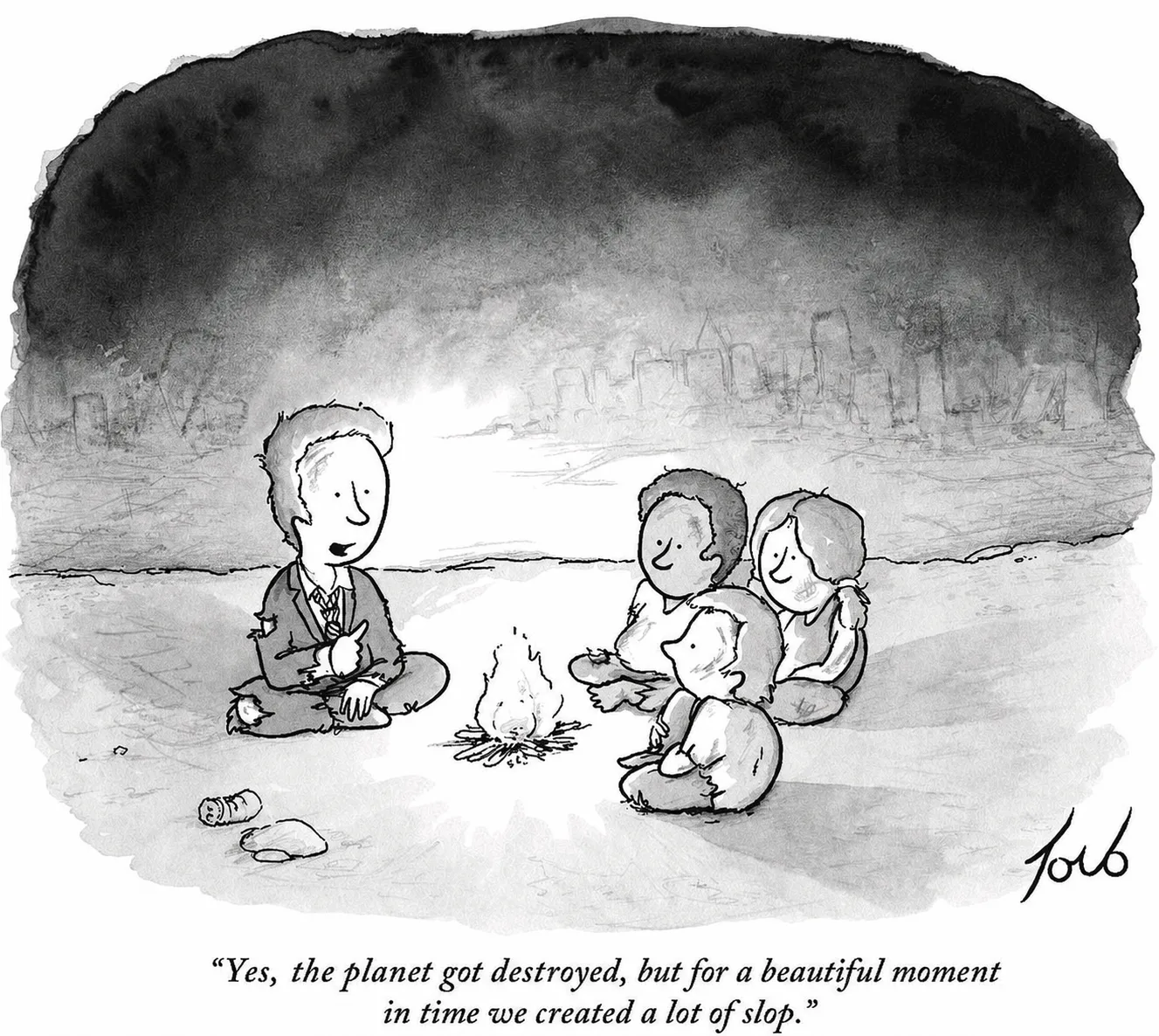
The slopocalypse is coming, and it will be televised, and fed by us.
Strava is the new Zillow

Another chapter in one of my favorite categories: technology used for unintended purposes.
This week the idea of using Strava, the social network for runners, to decide which part of a city to buy or rent a house in started going viral.
Strava has a Global Heatmap, a map showing where users have been running over the past year.
The idea is simple: the places where lots of people choose to go running usually have parks, sidewalks, lighting, nice routes and, above all, safety. Before moving to a city you don’t know, you look at where people run.
Does this have anything to do with the creative industries? No. But also yes. Tools and the use we give those tools are two different categories, and when we misuse tools, interesting things happen.
Five futures of content
Today we have five small signals that together paint a bit of the picture of the future of entertainment and content.
🦹♀️ A few Tuesdays ago we talked about Character.AIopening a microdrama division. Now there’s some data.
According to the company, more than 40% of the users who finished Last Summer then opened a chat with one of the characters. Among those who chatted, 25% came back for several conversations.
🐽 That same logic of turning characters into conversational characters is already landing in kids’ content. WildBrain bought Personality AI, the company behind Hey Peppa Pig, which lets children talk and play with Peppa Pig.
Personality AI presents itself as safe by design in order to target a children’s audience.
✍️ On another front, Sunny Hostin closed a deal with Fountain 0 to develop adaptations of her novels and license her likeness to appear digitally inside those productions.
The model is what’s interesting: the creator keeps the IP, licenses the adaptation, and separately licenses her own identity as part of the cast.
👾 The Guild was a web series that premiered 20 years ago. Creator Felicia Day decided to make The Guild movie. To do it, instead of going to a studio she went to The Guild’s fan community (all grown up 20 years later).
The film closed its Kickstarter campaign with almost 7 million dollars in funding, making it the biggest film project in Kickstarter history. It’s once again what we keep insisting on at SOUTS: build the audience first, scale after.
🐿️ Arcana Labs is going to produce The Furry Wild West, an AI-assisted animated feature. The process: humans write, design the characters, define the settings, do the storyboards and lay out every shot. AI is used only during animation, to generate shots and the movement between images.
This is the workflow that works best today, and it’s the difference between creative content and slop. Next week we’re going to put together a video about exactly this: the different ways of creating content with AI and what you gain and lose with each one.
It’s one of those weeks where we watch content creation change without a single big announcement to explain it.
That was Tomorrow Tuesday, the weekly newsletter. If you want to subscribe, subscribe!
At SOUTSwe try to always stay on top of what’s happening, and every time there’s something relevant we’ll bring it to you in this newsletter.
See you next Tomorrow Tuesday.
Yves
